Tahquamenon Falls: What’s Actually Accessible (2026)
Tahquamenon Falls is one of the more accessible waterfall destinations in Michigan’s Upper Peninsula — but “accessible” means different things depending on what you need, and most sources online either oversimplify it or repeat outdated information. This guide breaks down what’s accessible at both falls, what isn’t, and what’s changed recently, covering mobility, vision, hearing, and sensory needs.
Wandering Michigan Wisconsin contains affiliate links. If you make a purchase using one of the links below, we may receive compensation at no extra cost to you. We only recommend products and services we use and trust.
Read our disclaimer for more information.

Plan Your Trip With My Favorite Resources
Best accommodation site: Booking.com
Book day tours here: Viator.com
Purchase travel insurance here: SafetyWing
Is Tahquamenon Falls Accessible?
Yes, in real and substantial ways — the park has invested real money in accessibility infrastructure over the past several years, including a 2022 pedestrian bridge project and a completed boardwalk at the Upper Falls. But accessibility looks different at the Upper Falls, the Lower Falls, and the trail connecting them. Below is the honest breakdown for each.
What the Park Service Told Me
I contacted Tahquamenon Falls State Park directly to verify the current accessibility information. Sarah Anderson from the park service office confirmed that the areas around both the Upper Falls and Lower Falls are fully accessible, and visitors can use their own personal mobility aids.
The park also has wheelchairs available, but they are first come, first served. Sarah said demand can be high, particularly since the new accessible Upper Falls boardwalk was completed.
Tahquamenon Falls State Park Tours
Upper Falls Accessibility
The Upper Falls is the more developed and more reliable of the two areas for accessibility.
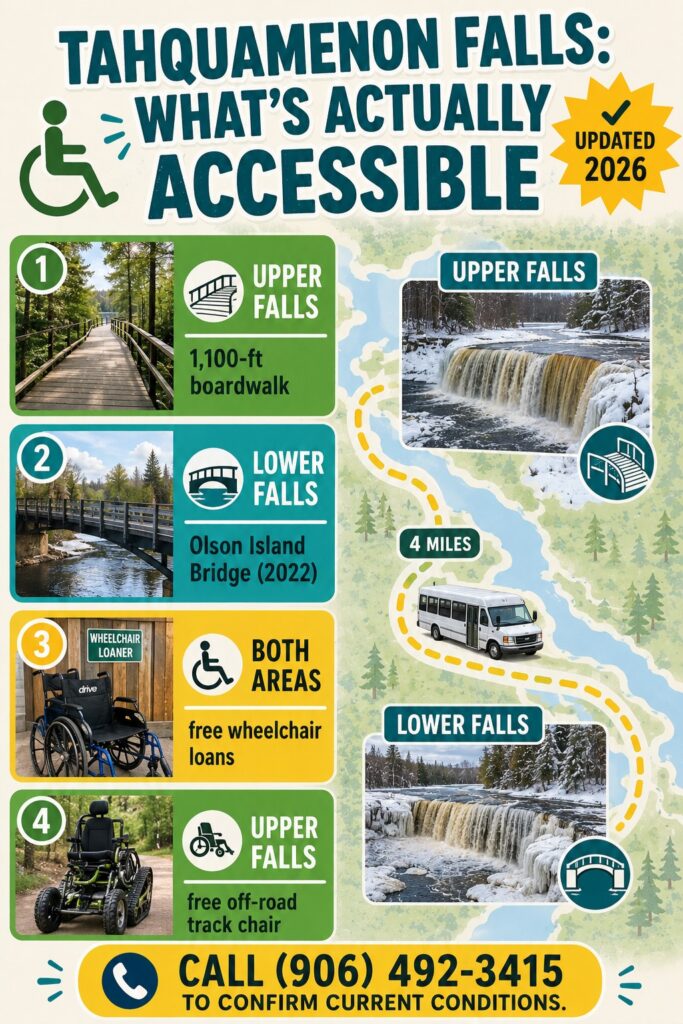
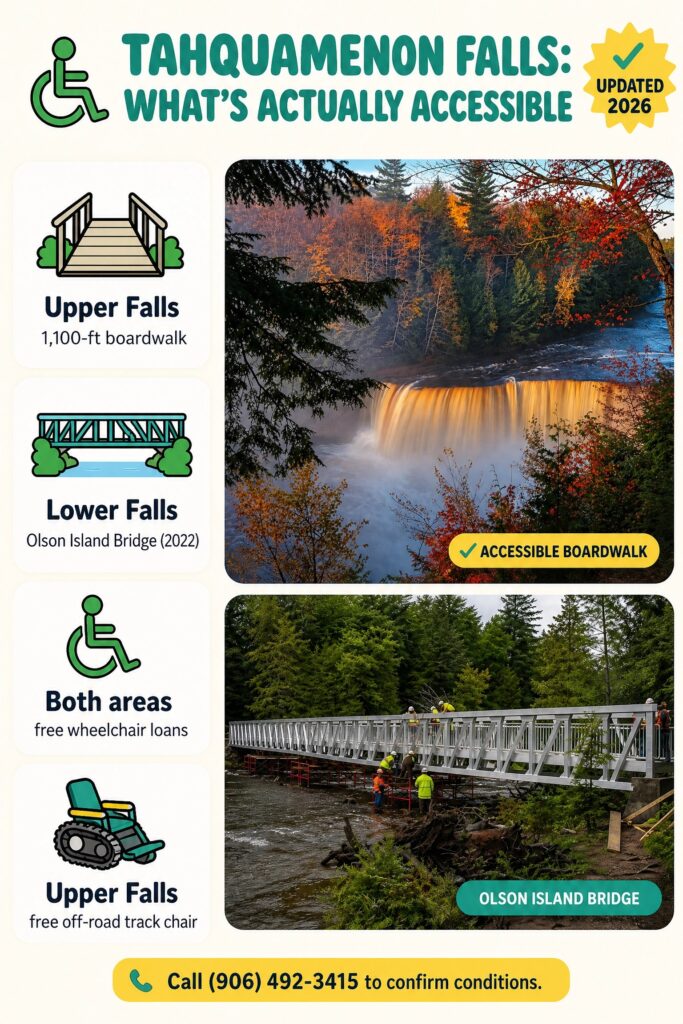
The boardwalk: A 1,100-foot accessible boardwalk leads to the brink of the Upper Falls, complete with five switchback landings featuring interpretive displays and benches along the way. This replaced the old staircase route entirely — funded by a $1.5 million federal relief grant. If you’ve seen older information describing this as “under construction” or citing a 900-foot length, that’s outdated; it’s complete.
The paved path: Beyond the boardwalk, three accessible viewing platforms sit along a paved path from the parking lot, roughly 0.4 miles on flat surface.
Restrooms: ADA-accessible, non-gender restrooms are available at the Upper Falls day-use area.
Dining: The Tahquamenon Falls Brewery & Pub is fully accessible, with wide entryways and spacious dining areas.
What’s not accessible here: Some older viewing platforms near the brink of the falls still require stairs for the closest vantage points, if you’re seeking an angle beyond what the boardwalk and main platforms offer.
The New Upper Falls Boardwalk
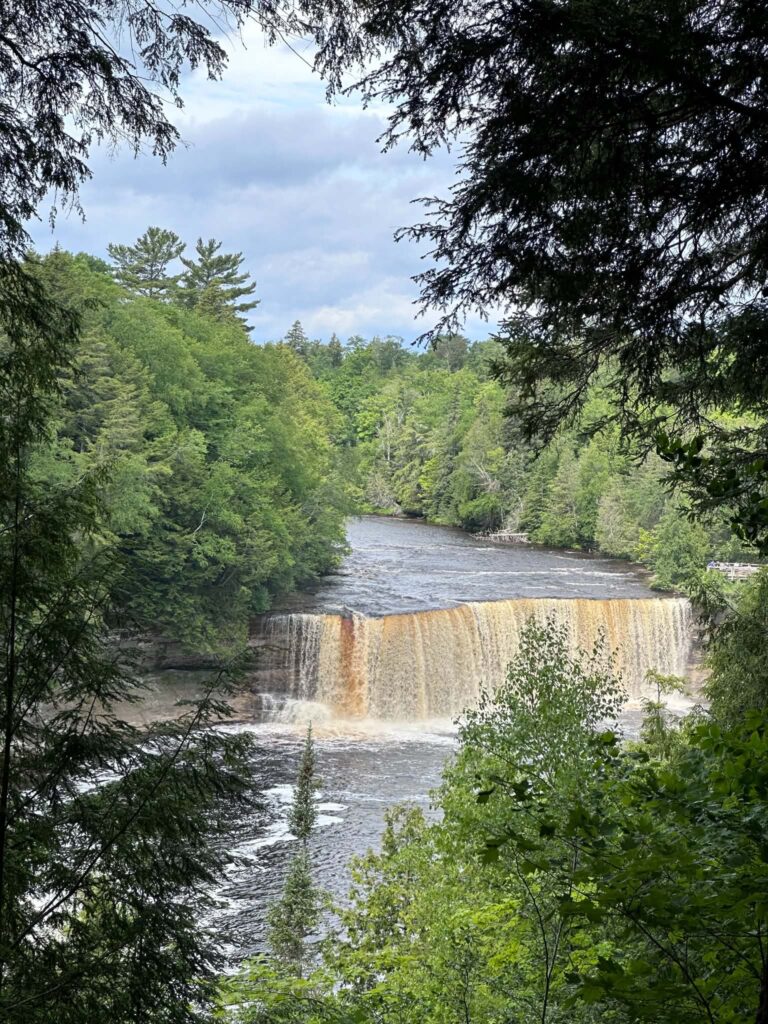
The biggest accessibility improvement in 2026 is the new 1,100-foot fully accessible boardwalk at the Upper Falls. It replaced the former staircase route and provides an accessible way toward the brink, with switchback landings, benches and viewing opportunities.
For visitors with mobility limitations, this significantly changes what is possible at the Upper Falls.
Lower Falls Accessibility
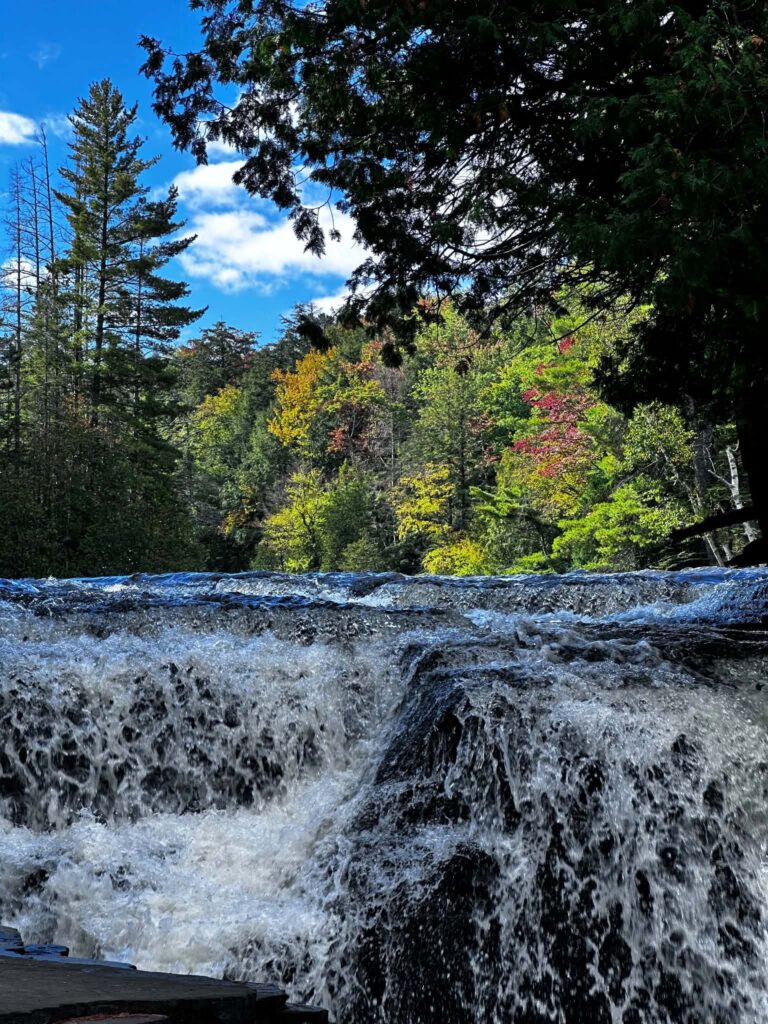
The Lower Falls area works on a different model — it’s centered on an island in the middle of the falls, and accessibility here has improved a great deal since 2022.
The path: A roughly 0.4-mile flat, paved path leads from the parking lot to the riverbank viewing areas.
The Ronald A. Olson Island Bridge: Opened in 2022 (a $1.28 million project), this 142–143-foot pedestrian bridge is the single biggest accessibility improvement at the Lower Falls — before it existed, reaching the island required a rowboat. The bridge connects to a 350-foot boardwalk and a half-mile barrier-free trail circling the island, with benches along the way.
What’s not accessible here: If you’d rather skip the bridge, the traditional route is a rowboat rental — not wheelchair accessible. Some sources also mention 116 steps down to the base of the gorge for a different, closer vantage point; that’s an optional alternate route, not the main accessible path.
Getting Between the Falls
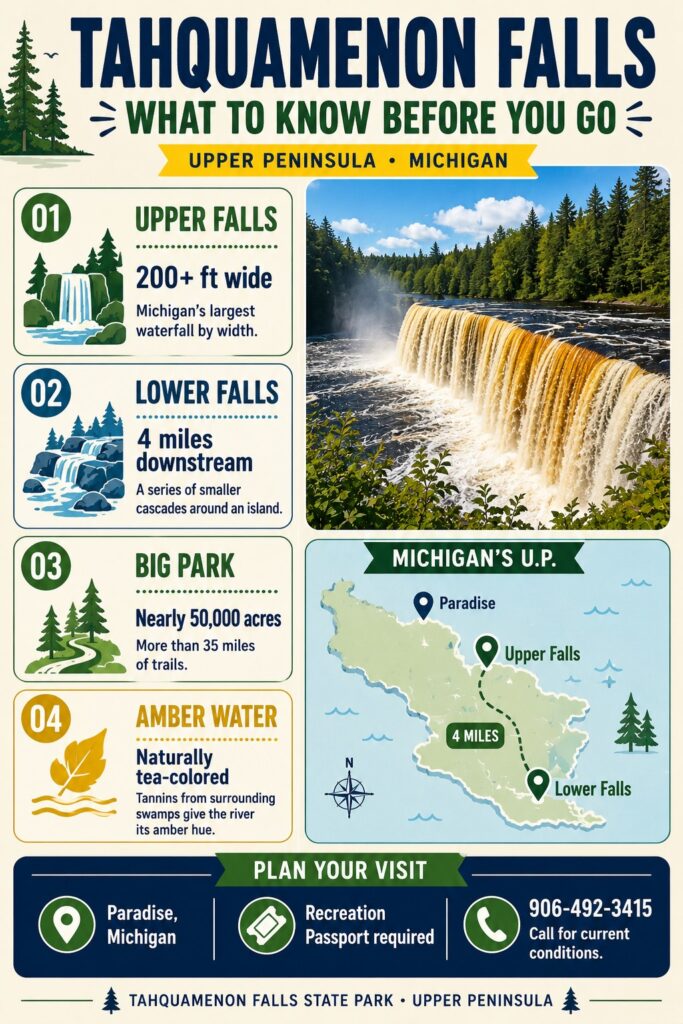
The Upper and Lower Falls sit about 4 miles apart. A seasonal shuttle runs daily between them from mid-June through Labor Day — worth knowing if walking or hiking the full distance isn’t realistic for you. Ask the park office at (906) 492-3415 for current shuttle details, since schedules can shift.
Mobility Equipment
Track chair: A free, off-road motorized track chair is available at the Upper Falls, built to handle snow, rough terrain, and standing water. Note on a real source discrepancy: the Michigan DNR’s own official track chair program page states an 8-inch water rating and first-come, first-served access only, with no reservation system. A separate regional tourism source describes a 6-inch water rating with a reservation option. We’d trust the DNR’s own page as the primary source, but call (906) 492-3415 to confirm current policy before you go, since this is exactly the kind of detail worth double-checking for your trip.
Standard wheelchairs: Free to borrow, available at both the Upper and Lower Falls, first-come, first-served.
Bring Your Own Mobility Aid: One detail I especially wanted to confirm: you can use your own wheelchair or other personal mobility aid in the accessible areas. You don’t have to rely on a park wheelchair.
Vision
Snow and ice reduce path contrast in winter and can obscure curb edges; even outside winter, tree-shaded sections of the boardwalks create sharp light/shadow transitions worth knowing about in advance. The falls’ own roar is a strong, natural orientation cue near both viewing areas. Interpretive signage along the Upper Falls boardwalk is posted at the switchback landings — ask at the Fact Shack whether large-print or tactile versions are available.
Hearing
There’s no posted audio alert system in the park; ranger contact is by phone rather than announcements, so save (906) 492-3415 before you go rather than relying on posted signage. The falls’ ambient roar is loud enough to interfere with verbal communication at close range near the main viewing platforms — worth planning for if you’re coordinating a group.
Sensory
The park is large and wooded through most of its acreage, which keeps crowd noise diffused outside of the two main day-use areas — a real advantage over more compact tourist sites. The Upper Falls area (boardwalk, Brewery & Pub, gift shop) is the busiest and loudest zone; the Lower Falls island trail is the quieter option. If sensory overload is a concern, visiting the Lower Falls first and building in breaks at the Brewery & Pub (a calm, indoor space) is a reasonable strategy.
Accessible Picnic Areas
Accessible picnic areas with tables and charcoal grills (first-come, first-served) are located at: – Whitefish Bay Picnic Area – The Lower Falls day-use area – The Upper Falls day-use area
Not accessible: The picnic area at the Stables, located between the Upper and Lower Falls, is not listed as accessible.
Service Animals and Pets
Dogs are welcome throughout the park on a leash up to 6 feet, regardless of size — just make sure vaccinations are current. Trained service animals are permitted under ADA regulations everywhere pets may otherwise be restricted, and are not required to be certified — staff may only ask whether the animal is a service animal required because of a disability and what task it’s trained to perform. If you’re bringing a dog with its own mobility limitations, note that some optional vantage points (like the 116-step descent at the Lower Falls) involve stairs your dog may not be able to manage — stick to the boardwalk routes.
Winter Accessibility
Tahquamenon Falls State Park is open year-round. Sarah Anderson confirmed that the Upper Falls path is cleared during winter, while the Lower Falls area has snowshoe trails.
Winter conditions can still make mobility more challenging, so I recommend checking current conditions with the park before traveling.
Nearby Accessible Stop: Whitefish Point
If you’re building accessibility into your whole trip, Whitefish Point (about 30 minutes from the park) is worth adding. The Great Lakes Shipwreck Museum has accessible exhibits and barrier-free entrances and restrooms, connected by paved walkways throughout, plus a boardwalk to the shoreline (stairs at the end lead to the beach itself for those who want sand access). See 11 Winter Birds of Michigan for more on the adjacent bird observatory.
Tahquamenon Falls Accessibility: FAQ
Substantially, yes. The Upper Falls has a 1,100-foot accessible boardwalk and paved paths; the Lower Falls has an accessible bridge, boardwalk, and barrier-free island trail. A few optional vantage points (stairs, rowboat) are not wheelchair accessible, but the main viewing experience at both falls is.
Yes — free standard wheelchairs are available at both the Upper and Lower Falls, first-come, first-served. A more capable off-road track chair is also available at the Upper Falls for rougher terrain.
Yes, since 2022 — the Ronald A. Olson Island Bridge connects to a barrier-free boardwalk and trail around the island. Before 2022, the only way to the island was by rowboat, which is not wheelchair accessible.
Yes, ADA-accessible restrooms are available at the Upper Falls day-use area.
Yes — wide entryways and spacious dining areas make it a comfortable, fully accessible stop after time on the trails.
Yes, seasonally — mid-June through Labor Day, running daily. This can be a useful option if walking the 4 miles between falls isn’t realistic for you. Confirm current schedule with the park office.
Yes. Trained service animals are permitted under ADA regulations wherever pets might otherwise be restricted, and don’t require certification.
If mobility is a primary concern, the Upper Falls’ 1,100-foot boardwalk is the most developed single accessible experience in the park. If you want the island experience, the Lower Falls’ bridge-and-boardwalk route is the better pick — just budget more time, since it’s a longer path overall.
Accessibility Information Verified With the Park
I appreciate Sarah Anderson taking the time to answer my questions. Her information helped me confirm the practical details that matter most: both waterfall areas are accessible, visitors can use their own mobility aids, and park wheelchairs are available on a first-come, first-served basis.
Information provided by Sarah Anderson of Tahquamenon Falls State Park and checked against current Michigan DNR information.
More Wandering Michigan Wisconsin
17 Best Things to Do at Tahquamenon Falls
Tahquamenon Falls Hiking: Routes & Tips