11 Winter Birds of Michigan: 2026 ID Guide
Michigan’s diverse landscape — Great Lakes shoreline, dense forest, open farmland — makes it one of the best states in the country for winter birding. Some species stick around year-round. Others arrive from the Arctic and Canada specifically because Michigan winters are mild by comparison. This guide covers the 11 birds you’re most likely to see between November and March, where to find each one, and the trails and refuges built for birders — including accessibility notes for each.
Wandering Michigan Wisconsin contains affiliate links. If you make a purchase using one of the links below, we may receive compensation at no extra cost to you. We only recommend products and services we use and trust.
Read our disclaimer for more information.
Winter Birds of Michigan
1. Northern Cardinal
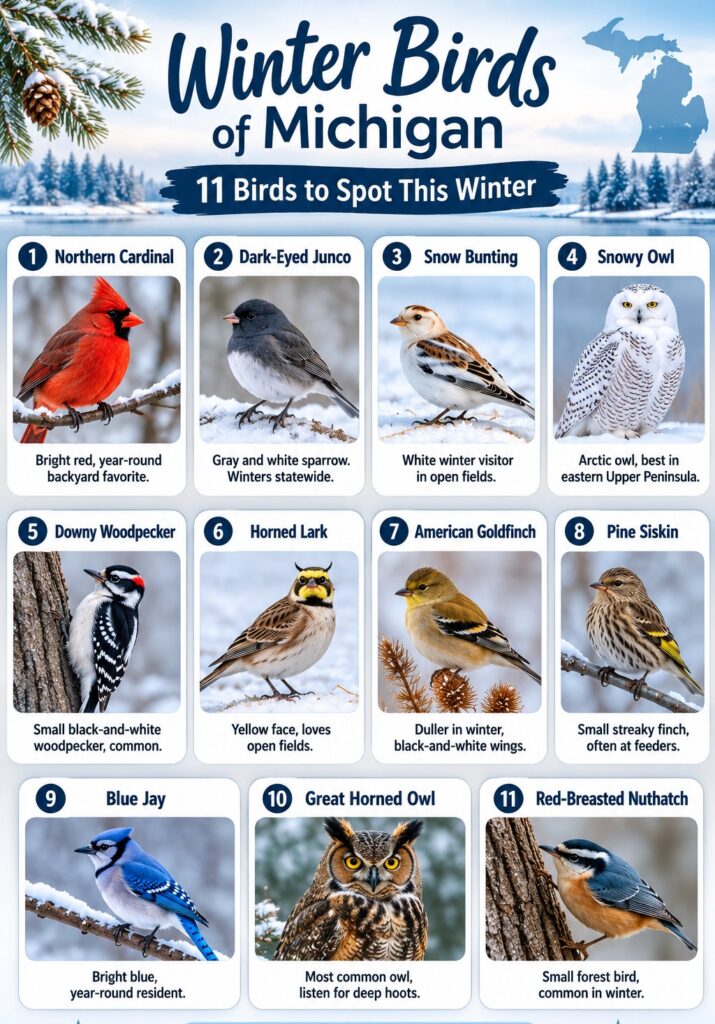
Year-round residents, most common in the southern Lower Peninsula but present statewide. Males are bright red with a black face mask; females are pale brown with red tinges and the same black mask. Reliable at backyard feeders all winter.

2. Dark Eyed Junco
A medium-sized sparrow with a round head, long tail, and white outer tail feathers visible in flight. Slate-gray above, white belly. Juncos breed farther north and winter throughout Michigan — not just the southern part of the state, as sometimes reported. One quirk worth knowing: roughly 80% of Michigan’s wintering juncos are male. The females mostly continue farther south, while males risk the harsher winter to be first back to the breeding grounds in spring.
3. Snow Buntings
An Arctic breeder that winters in Michigan’s open country. Snowy white wings with rusty-brown patches — coloring that blends into snowy fields. Found in large open areas, especially farm fields with exposed seed, and sometimes at backyard feeders.
4. Snowy Owl
Snowy Owls move south from the Arctic each winter, typically arriving in December and departing by March. The eastern Upper Peninsula is the most reliable place to see one — wide-open spaces and abundant small prey draw them in every year. The Rudyard–Pickford area in particular has hosted between 30 and 50 individual owls in recent winters. Sightings elsewhere in the state are possible but unpredictable; some years produce none downstate at all.
Resource: For current sighting locations, check the EUP Winter Birding Map or eBird.
5. Downy Woodpecker
Michigan’s smallest woodpecker, found statewide year-round. Black-and-white checkered pattern; males have a small red patch on the back of the head. Common in open woodlands, city parks, and at suet feeders.

6. Horned Larks
North America’s only native lark. Yellow face with a black mask and small “horned” feather tufts. Found in open fields, farmland, and along lakeshores across Michigan — including a fondness for airports, thanks to the wide-open ground.
7. American Goldfinch
Present in Michigan year-round, though winter plumage is duller than the bright breeding-season yellow. Look for black-and-white wing markings year-round as a reliable ID feature regardless of season. Common in meadows, fields, and at backyard thistle feeders.
8. Pine Siskin
A small, streaky brown finch with yellow wing and tail markings. Present in the northern Upper Peninsula year-round, but winter can push them statewide depending on the year’s seed crop. Found in forests, weedy fields, and at feeders.

9. Blue Jays
Year-round Michigan residents. Some individuals migrate short distances within the state; others stay put all winter. Bright blue with black-and-white markings, commonly seen in parks, backyards, and oak or pine stands.
10. Great Horned Owl
Michigan’s most common owl, identifiable by yellow eyes and two feathered head tufts. Mostly nocturnal, so you’re more likely to hear one than see one — listen for deep hooting at dusk or just before dawn. Winter’s lower food supply pushes their hunting activity earlier in the evening, improving your odds of a sighting.
11. Red-Breasted Nuthatch
A small songbird more common in Michigan during winter than summer. Blue-gray above with a rust-colored belly and a black eye stripe. Found in forests, especially among oak, birch, maple, and pine.

Best Places for Winter Birdwatching in Michigan
Sleeping Bear Birding Trail
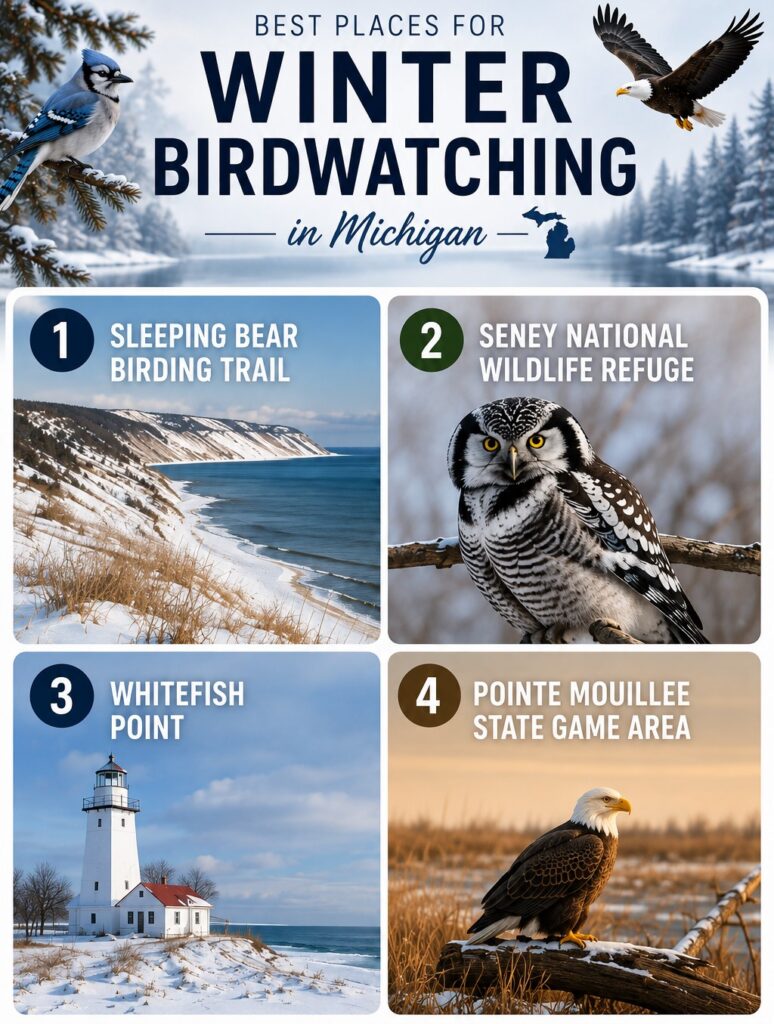
A 123-mile trail following M-22 from Manistee to Traverse City, anchored by Sleeping Bear Dunes National Lakeshore. Home to the endangered Piping Plover in season, plus a strong winter raptor and waterfowl presence along the Lake Michigan shoreline.
Accessibility: Sleeping Bear Dunes runs one of the strongest accessibility programs of any Michigan park. Three free track chairs (all-terrain motorized chairs) are available on the Bay View Trail, the Platte River Campground/Railroad Grade Trail, and Alligator Hill — but reservations only run Memorial Weekend through mid-October, so they are not available for a winter visit. Year-round, the paved 20-mile Sleeping Bear Heritage Trail and the shorter Duneside Trail (0.9 miles) remain wheelchair accessible regardless of season, weather permitting. The Philip A. Hart Visitor Center stays open year-round with shorter winter hours (8:30am–4pm vs. summer’s 8am–6pm) — call (231) 326-4700 or email sleepingbearinfo@nps.gov ahead of a winter trip to confirm current trail and parking conditions.
Seney National Wildlife Refuge (Superior Birding Trail southern anchor)
The Superior Birding Trail runs 150 miles between Seney National Wildlife Refuge and Whitefish Point, through some of the best winter owl and raptor territory in the Midwest.
Accessibility: Seney’s Pine Ridge Nature Trail includes a genuinely accessible boardwalk segment — hard surface, roughly 4–5 feet wide, minimal grade — leading toward the Whitefish Point-area habitat. This is one of the more reliably accessible birding stops in the eastern UP. Worth knowing: the refuge itself is open daily dawn to dusk year-round, but the visitor center and its main driving loops are only staffed May 15–October 20. Outside that window, staff may be out in the field rather than answering the phone, so email Seney@fws.gov is your most reliable way to confirm current boardwalk and winter access conditions before a winter visit.
Whitefish Point
The northern anchor of the Superior Birding Trail and a globally recognized Important Bird Area, with over 340 recorded species — the most of any single site in Michigan. Worth knowing: Whitefish Point is at its best in spring and fall migration: winter itself is a quieter, harsher season here by the observatory’s own account, though finches and other hardy species are still present. Whitefish Point Bird Observatory has an observation platform, trails, and on-site naturalists.
Accessibility: The boardwalk trail out to the Lake Superior shoreline is wheelchair accessible. Call WPBO at (906) 492-3596 to confirm current winter conditions.
Also your best base for combining a birding stop with a Tahquamenon Falls winter visit — the two are close enough to pair in one trip.
Pointe Mouillee State Game Area
A wetland complex south of Detroit on Lake Erie, home to over 300 bird species including bald eagles and osprey. Free, year-round access via three marked entrance points.
Accessibility: 7 to 10 miles of flat, gravel dike trails wind through the marsh — walkable and generally manageable for wheeled mobility devices, though the surface isn’t officially rated ADA-accessible, so call ahead if you need specifics for your equipment.
Safety note: Pointe Mouillee is an active hunting area, with waterfowl hunting season typically running into March — meaning it overlaps directly with peak winter birding season. Wear blaze orange and check current hunting schedules with the DNR (734-379-9692) before a winter visit.
Guided Birding Tours at Whitefish Point
Worth knowing, even though neither runs during the depths of winter: Michigan Audubon offers a two-day guided fall migration tour at Whitefish Point Bird Observatory (next dates: September 12–13 and October 3–4, 2026; $175 for members, $200 for non-members, meals and lodging not included). It’s a strong option if your trip timing has any flexibility toward fall rather than peak winter. See current tours, or email birds@michiganaudubon.org with questions.
Friends of Whitefish Point runs a similar guided fall tour, also centered on October migration, with proceeds funding the observatory’s long-term owl-banding research. Check current tour dates, or call WPBO directly at (906) 492-3596.
A caveat worth passing on: by Whitefish Point’s own account, deep winter is actually its quietest birding season — most of the spectacular migration counts happen in spring and fall. For winter specifically, your best bet remains the eastern UP’s open country around Rudyard and Pickford for Snowy Owls, covered above, rather than Whitefish Point itself. If you want a guided experience, plan around one of the fall tour dates instead and pair it with your winter trip planning for a different visit.
Accessibility Notes for Winter Birding
Beyond trail and terrain access, a few things are worth knowing across all four categories before you head out:
Vision: Winter birding relies heavily on visual ID against snow glare, which can wash out subtle plumage details. Polarized or anti-glare optics help. The free Merlin Bird ID app (Cornell Lab) includes a photo-ID feature as a backup when a bird’s field marks are hard to distinguish at a distance.
Hearing: Several species on this list — especially the Great Horned Owl — are identified more often by call than by sight. If you’re hard of hearing or prefer not to rely on audio cues, Merlin’s Sound ID feature transcribes bird calls into a visual species match in real time, and events like an owl-banding viewing (offered seasonally by Friends of Whitefish Point) let you see a bird up close without needing to hear it first.
Sensory: Much of the eastern Upper Peninsula’s winter birding — including the Rudyard–Pickford Snowy Owl route — is genuinely a drive-and-scan experience: you cover ground by car with brief stops to get out and look, rather than long stationary waits in open wind. That makes it a reasonable option for anyone sensitive to cold exposure or extended time outdoors. Built-up locations like Whitefish Point’s Owl’s Roost and observation platforms offer a warm-up point between stretches outside.
Mobility: Covered location by location above — see Sleeping Bear Dunes, Seney NWR, Whitefish Point, and Pointe Mouillee for specifics.
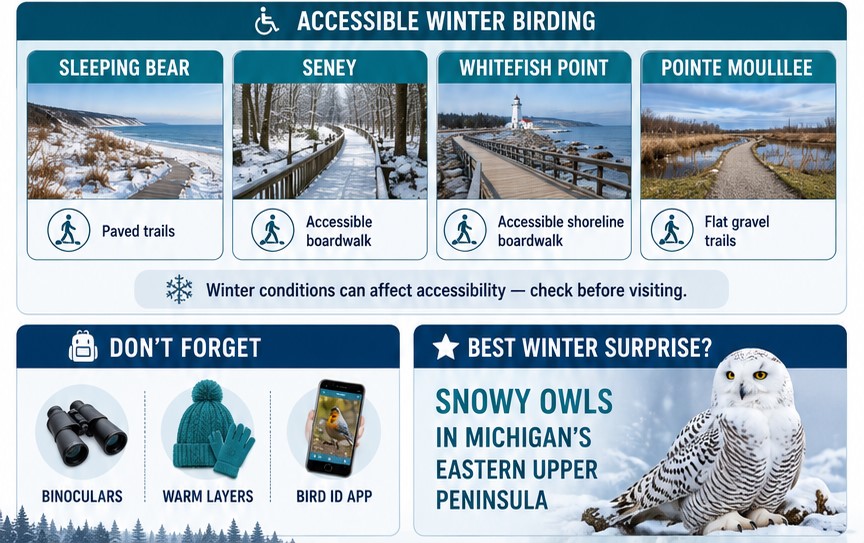
What to Pack for Winter Birding
- Insulated, waterproof binoculars rated for cold weather
- A field guide or the free Merlin Bird ID app (Cornell Lab) for identification in the field
- Layered clothing and hand warmers for long stationary viewing in open, windy terrain

Quick Reference — Contact Info for Your Visit
Sleeping Bear Dunes National Lakeshore (231) 326-4700 | sleepingbearinfo@nps.gov | 9922 Front Street, Empire, MI 49630 Visitor center open year-round, shorter hours in winter (8:30am–4pm)
Seney National Wildlife Refuge Seney@fws.gov | (906) 586-9851 Visitor center staffed May 15–Oct 20 only — outside that window, email is your best bet since staff may be out in the field rather than at a desk phone
Whitefish Point Bird Observatory (906) 492-3596 | birds@michiganaudubon.org
Pointe Mouillee State Game Area (DNR Wildlife Field Office) (734) 379-9692
Michigan Audubon Tours michiganaudubon.org/upcoming-trips-workshops | birds@michiganaudubon.org
Friends of Whitefish Point friendsofwp.org/tours
Winter Birds of Michigan: FAQ
Northern Cardinals, Blue Jays, Downy Woodpeckers, and American Goldfinches all stay in Michigan through the winter. Some Blue Jays migrate short distances within the state, but many remain in place all season.
No. Some species stay year-round, others arrive specifically for winter — like Snowy Owls and Snow Buntings coming down from the Arctic — and some, like Dark-eyed Juncos, are winter-only visitors that breed farther north.
Yes. Blue Jays are present in Michigan year-round, including winter. Look for them in parks, backyards, and among oak or pine trees.
The eastern Upper Peninsula, especially the Rudyard–Pickford area, is the most reliable location most winters. Sightings elsewhere in the state happen but are unpredictable year to year.
Suet feeders attract woodpeckers and nuthatches; tube and hopper feeders work well for cardinals, jays, and finches. Offering a mix gives you the best variety.
Yes — bare trees make birds easier to spot, and species like Snowy Owls and Snow Buntings are only present in winter, making it a genuinely different birding season from spring or summer.
It varies by location, but several spots have real infrastructure. Sleeping Bear Dunes offers free track chairs and beach wheelchairs, though the track chairs are only reservable Memorial Day through mid-October — not during winter. Its 20-mile Sleeping Bear Heritage Trail is paved and wheelchair accessible year-round. Seney National Wildlife Refuge has an accessible boardwalk segment. Whitefish Point’s shoreline boardwalk is wheelchair accessible. Pointe Mouillee’s dike trails are flat gravel, walkable but not officially ADA-rated. Call ahead for any location before a winter visit, since ice and snow can affect footing regardless of the surface type.
They typically begin arriving in December and are usually gone by March, though exact timing shifts year to year based on Arctic breeding success and food availability.
More Wandering Michigan Wisconsin
Tahquamenon Falls Winter: Complete 2026 Guide
Northern Michigan Winter: Ultimate Guide