Ludington State Park: Complete Guide (2026)
If you only have time to visit one Michigan state park, make it Ludington State Park. Sitting between Lake Michigan and Hamlin Lake, the park combines everything that makes Michigan’s west coast special – wide sandy beaches, towering dunes, forests, marshes, rivers, historic lighthouses, wildlife, and over 18 miles of hiking trails.
Unlike many beach parks that offer only swimming, Ludington lets you spend an entire weekend without running out of things to do. This is a complete, practical guide to visiting in 2026 – current fees, camping options, the lighthouse hike, trails, and the details (Recreation Passport rules, pet zones, cell service) that actually change how your trip goes.
Ludington State Park is located at the end of M-116, about 8 miles north of the city of Ludington, Michigan. Park office phone: (231) 843-2423.
Wandering Michigan Wisconsin contains affiliate links. If you make a purchase using one of the links below, we may receive compensation at no extra cost to you. We only recommend products and services we use and trust.
Read our disclaimer for more information.

Plan Your Trip With My Favorite Resources
Best accommodation site: Booking.com
Book day tours here: Viator.com
Purchase travel insurance here: SafetyWing
Ludington State Park: Quick Facts for 2026
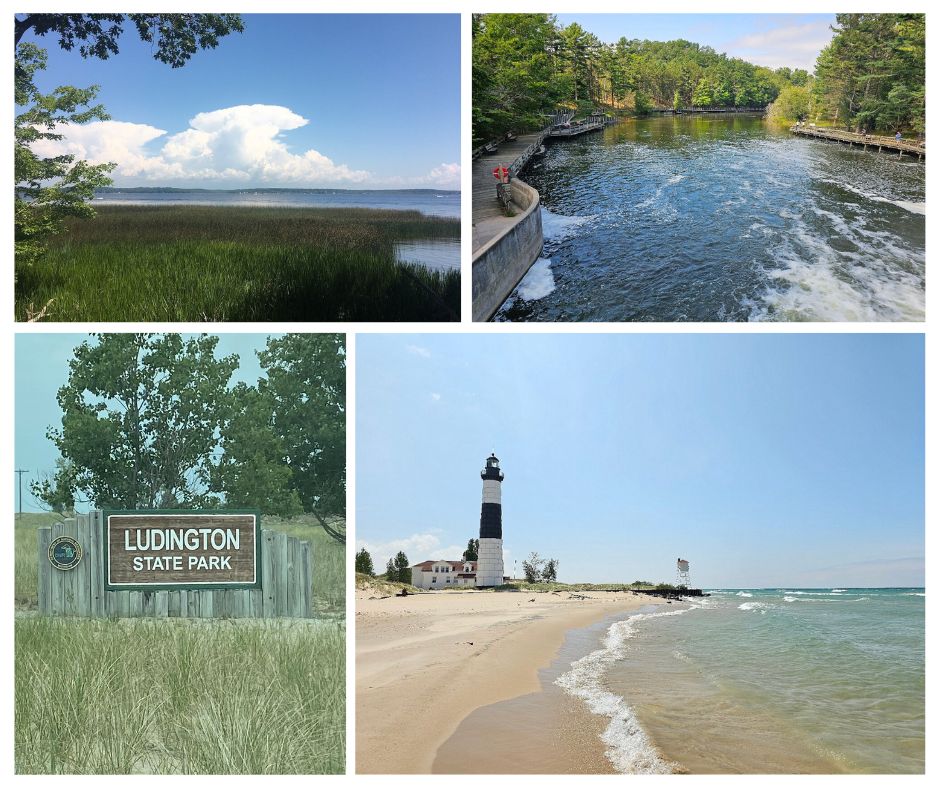
Ludington State Park sits on a narrow strip of land between two very different bodies of water – 7 miles of Lake Michigan shoreline on one side and the 5,000-acre Hamlin Lake on the other – with the Big Sable River cutting a mile-long connector between them. It’s consistently ranked among Michigan’s most popular state parks, and the numbers back that up: three campgrounds, over 20 miles of marked trails, and a lighthouse that draws hikers even from people who aren’t otherwise “lighthouse people.”
Approximate driving times:
- Grand Rapids: 2 hours
- Traverse City: 2 hours
- Muskegon: 1 hour 30 minutes
- Detroit: 4 hours
- Chicago: about 4½ hours
Ludington State Park: Quick Facts for 2026
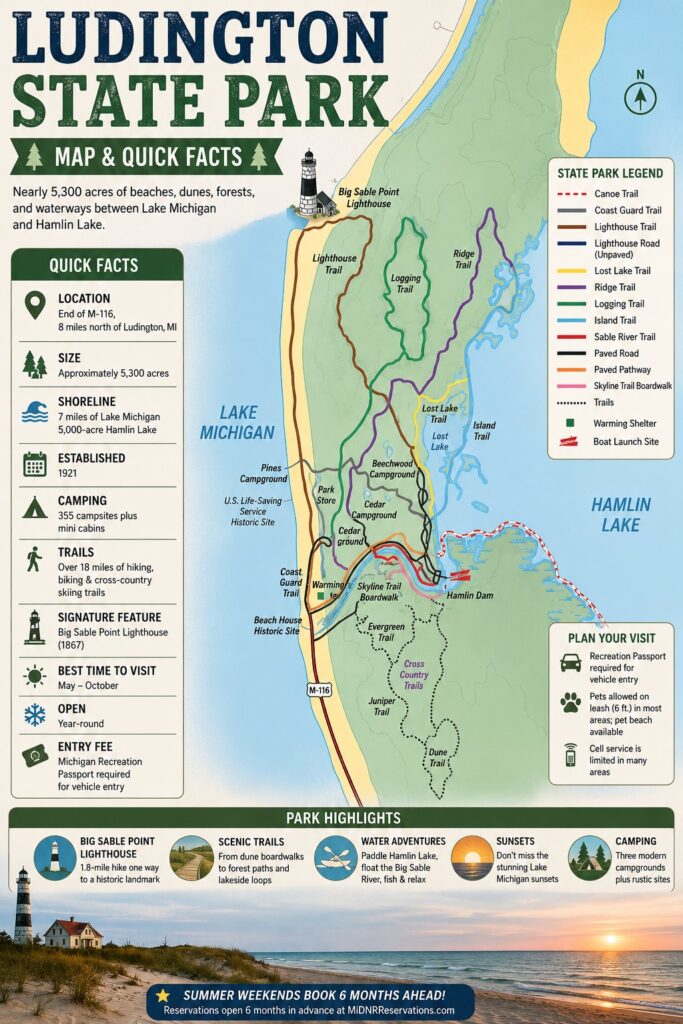
Location: End of M-116, roughly 8 miles north of Ludington, MI
Phone: (231) 843-2423
Size: Roughly 5,300 acres between Lake Michigan and Hamlin Lake
Signature features: Big Sable Point Lighthouse (1867), the Skyline Trail dune boardwalk, and 7 miles of Lake Michigan beach
Camping: 355 campsites plus mini cabins
Best Season: May through October
Open: Year-round
Recreation Passport & Fees
Every vehicle entering the park needs a Michigan Recreation Passport, and this trips up a fair number of first-time visitors because it’s separate from any camping fee you pay.
As of a January 1, 2026 fee adjustment, Michigan-resident pricing is:
- Resident annual (vehicle), purchased at license plate renewal: $15
- Resident 2-year option: $29
- Resident motorcycle: $7
- Resident moped: $7
For vehicles registered outside Michigan, the passport must be purchased separately (at the park gate, a DNR customer service center, or online in advance) rather than bundled with registration renewal — expect an annual nonresident pass in the neighborhood of $40 and a nonresident daily pass in the $11–$17 range, though these figures are adjusted periodically, so confirm the current rate before you go. If you buy your Recreation Passport at the park entrance instead of through your license plate renewal, a $5 convenience fee applies.
A few exceptions are worth knowing: you don’t need a Recreation Passport if you’re entering on foot or by bicycle, and it’s waived entirely during Michigan’s Free Fishing Weekends. The passport is also not valid at national parks or county/municipal parks — it only covers Michigan’s state-managed lands.
Camping is a separate cost on top of the Recreation Passport. Standard modern campsites generally run in the neighborhood of $25–$35 per night, with mini cabins and premium or pet-friendly sites priced higher (roughly up to $65/night depending on site type and season). Exact nightly rates are set by site type and season on the DNR’s reservation system.
Camping at Ludington State Park
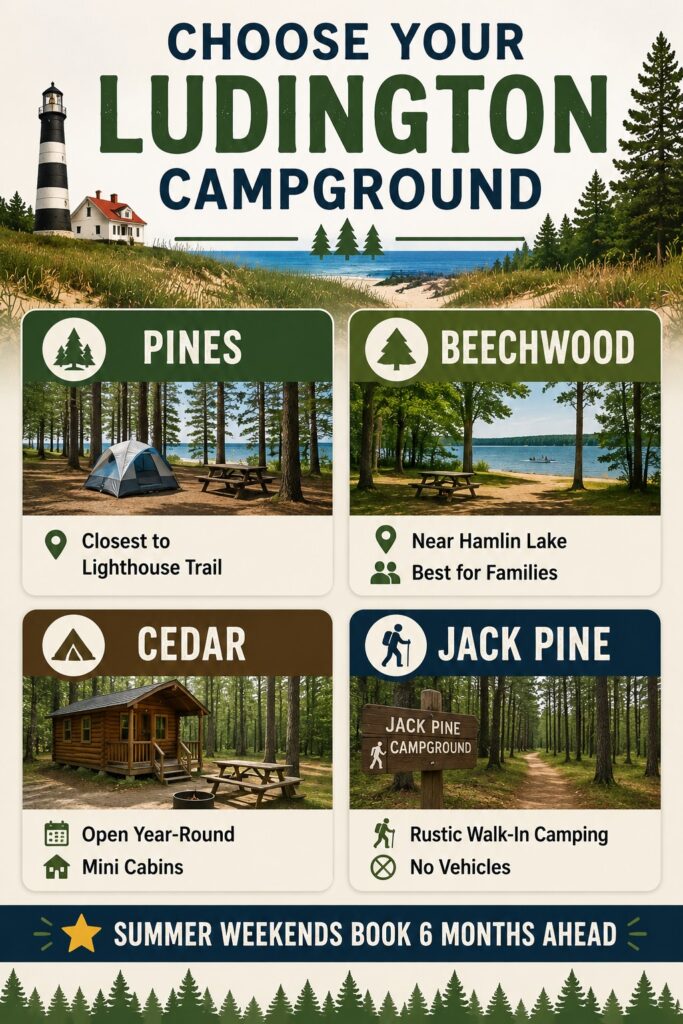
This is the reason a lot of people know Ludington by name before they’ve ever set foot in it: the campgrounds are legendarily hard to book. Summer weekend sites can sell out within hours of the booking window opening — 6 months in advance, to the day — through MiDNRReservations.com or by calling 1-800-447-2757.
The park has three modern campgrounds plus a set of rustic walk-in sites:
| Campground | Sites | Notes |
|---|---|---|
| Pines Campground | 99 sites | West side, near Lake Michigan; jumping-off point for the Big Sable Point Lighthouse path; heavily shaded, modest site sizes |
| Beechwood Campground | 147 sites | East side, near Hamlin Lake and the boat launch; larger, more shaded sites; connects to the popular Lost Lake–Island Trail loop |
| Cedar Campground | 114 sites (8 tent-only) | The only campground open year-round; center of the park near Dune Grass Concessions |
| Jack Pine (rustic, walk-in) | 10 sites | About a 1-mile hike in along the lighthouse path; vault toilets and a hand pump for water; no vehicles |
Each modern campground offers 20/30-amp electrical service, with some sites offering 50-amp, plus nearby sanitation stations. There are also four mini cabins scattered across the campgrounds — three standard and one pet-friendly (in Cedar Campground, which allows up to two cats or dogs for an additional $10/night/pet) — each sleeping five people with a double bed, three singles, a mini fridge, and an electric wall heater. Bring your own linens and cookware.
Booking reality check: if you want a summer weekend, set a reminder for exactly six months ahead and be ready the moment the booking window opens – sites can be gone within hours. Midweek stays and shoulder-season trips in May and September are dramatically easier to land, and Cedar Campground’s year-round status makes it the option for anyone chasing a quieter winter trip with cross-country skiing and snowshoeing.
If your reservation dates change, contact MiDNRReservations directly rather than skipping check-in – failing to check in or update your arrival date results in an automatic cancellation along with the loss of two nights’ fees, a non-refundable reservation fee, a $10 cancellation fee, and a reduced-stay fee. Staff can’t override this once it triggers.
Big Sable Point Lighthouse
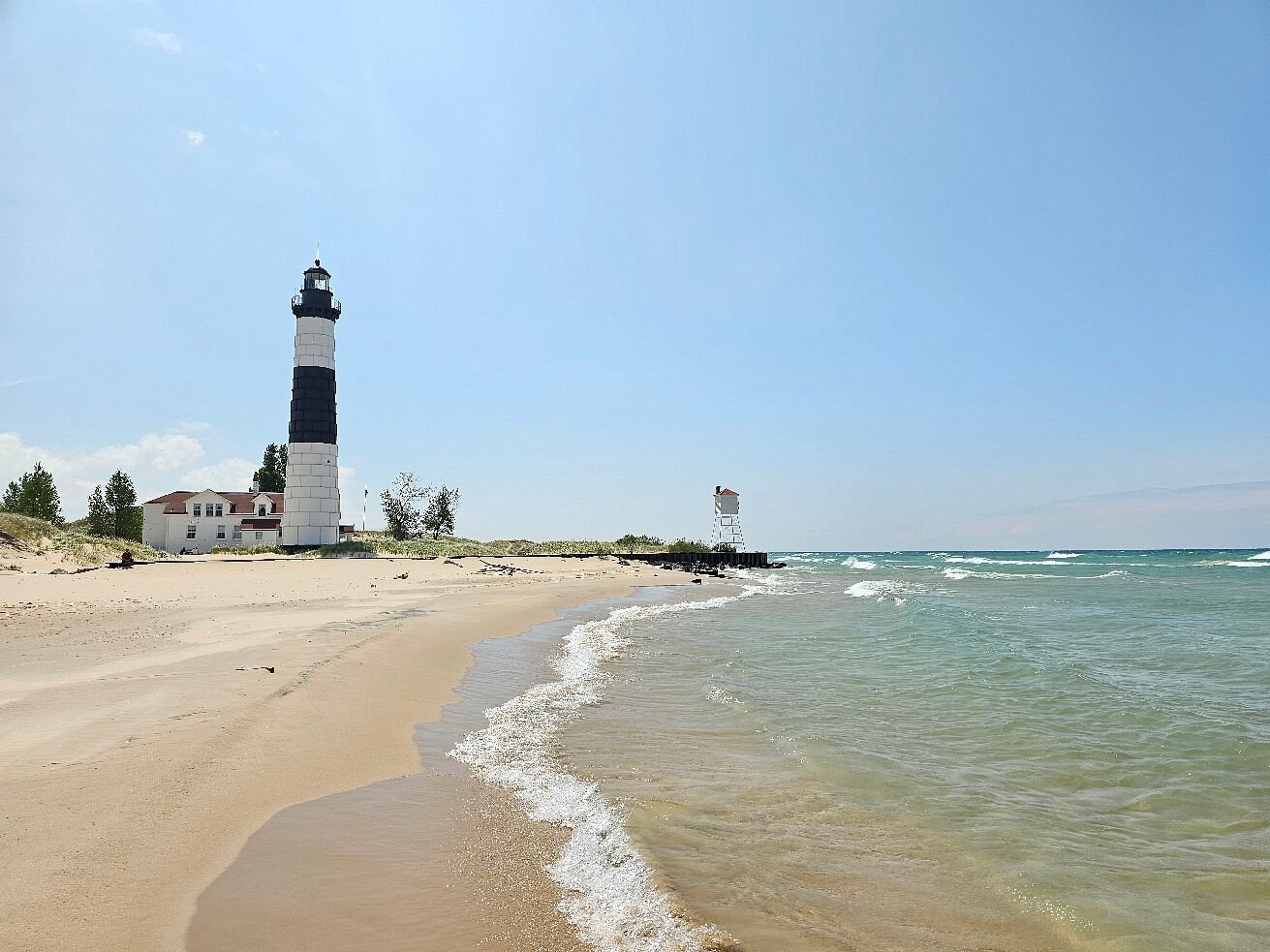
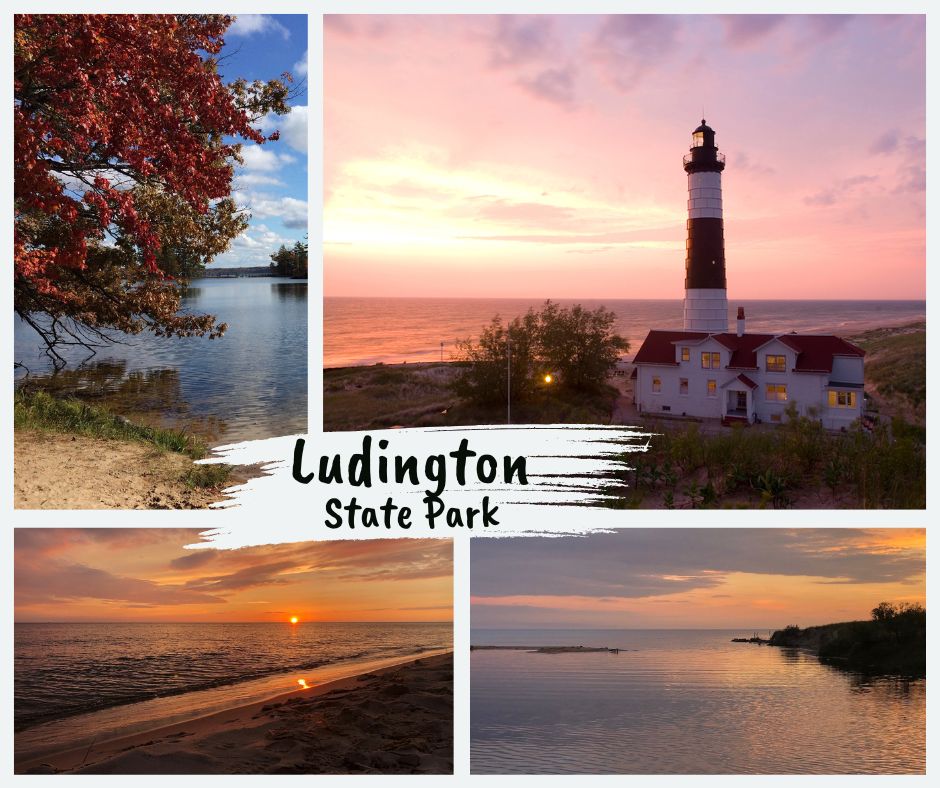
The black-and-white-striped lighthouse at the tip of Big Sable Point has been guiding ships since 1867, and reaching it is one of the park’s signature experiences precisely because you can’t drive there.
Getting there: The only way in is a 1.8-mile, one-way sand-and-gravel path starting from the Pines Campground, between campsites 58 and 59. It’s walkable or bikeable (road bikes will struggle with the sand), but there’s little shade along the way, so it’s genuinely more strenuous than the flat distance suggests, especially on a hot afternoon. Bring water. On the way back, you can retrace the path or — conditions and water levels permitting — walk back along the Lake Michigan shoreline instead.
Touring the lighthouse: The tower is open for tours, including a gift shop and a tower climb, May through October, run by volunteer keepers with the Lakeshore Keepers organization. Climbing the tower means roughly 130 steps, rewarded with a panoramic view over Lake Michigan and the dunes. A modest donation (commonly cited around $3) is suggested for the climb. Because it’s staffed seasonally by volunteers, hours can shift — if the tower climb is the main goal of your trip, it’s worth a quick call to the park office to confirm the lighthouse is open that day before you commit to the hike.
Trails & Hiking
Ludington has more than 20 miles of marked trails (some sources cite 18, others 21–24, depending on which connector loops are counted), ranging from flat lakeshore walks to dune climbs.
A few worth knowing by name:
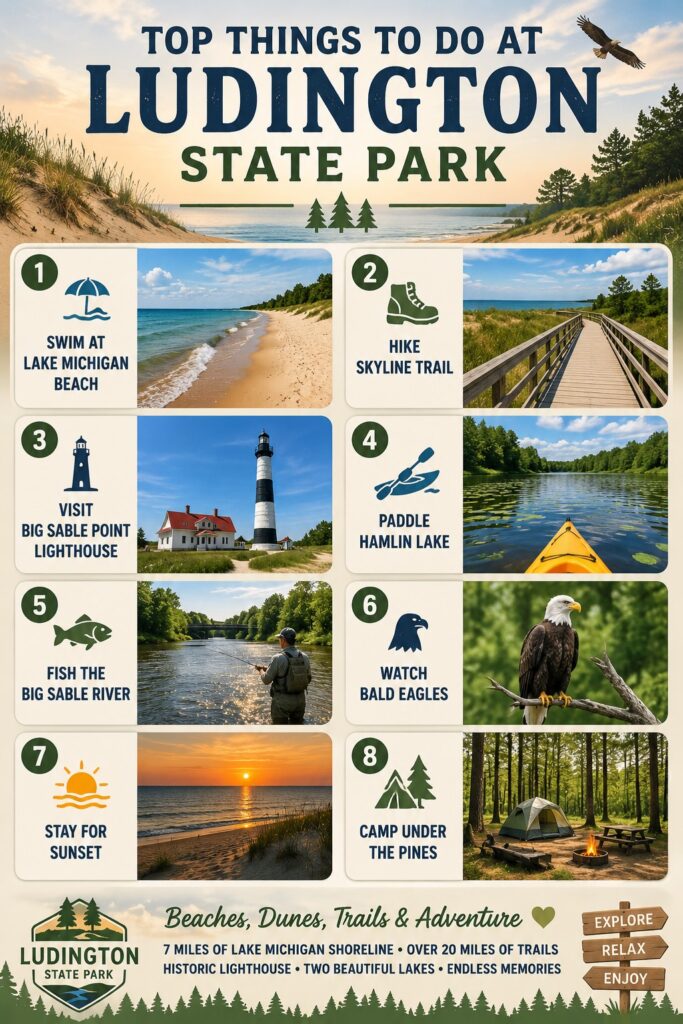
- Skyline Trail: An elevated boardwalk through the dunes with sweeping views south over Lake Michigan. It’s currently the subject of a $3.5 million renovation, a joint project between the DNR and the Friends of Ludington State Park, running from late 2026 into 2027 — expect some sections to be affected during that window. The trail also has EnChroma-enabled color-blind viewers installed by the Friends group, though reaching them requires climbing stairs.
- Lost Lake–Island Trail loop: One of the most popular loops in the park, winding through islands and over water via boardwalks near Hamlin Lake; a good pick for spotting wildlife, including bald eagles.
- Logging Trail: Starts at the north end of Pines Campground.
- Lighthouse Path: The 1.8-mile sand-and-gravel route to Big Sable Point Lighthouse, doubling as both a hiking and biking trail (see above).
A paved path also connects the campgrounds, the amphitheater, and day-use areas along the Big Sable River, which is the easier option if you’d rather bike than hike between park zones. In winter, several trail sections convert to cross-country skiing and snowshoeing routes, and Cedar Campground stays open to serve winter visitors.
Beaches, Paddling & the Big Sable River
Lake Michigan side is the one people picture: open water, real waves, dramatic sunsets, and 7 miles of sandy shoreline. The buoyed swim area near the Lake Michigan day-use area is the designated swimming zone.
Hamlin Lake side is calmer and more sheltered — better for young kids, canoes, and kayaks, with lily-pad-lined bayous near Lost Lake for beginners. Hamlin Lake also has a boat launch (accommodating boats up to 22 feet) and paddlesport rentals — kayaks, canoes, and stand-up paddleboards — through Dune Grass Concessions, available mid-May through early October.
The Big Sable River connects the two, running about a mile through the park, and it’s the park’s most distinctive water activity: floating, tubing, or paddling downriver between the lake and Hamlin Dam. Fishing is popular along the river and Lake Michigan shoreline, especially during spring and fall runs of salmon, lake trout, steelhead, and brown trout. Note that special fishing regulations apply on the Big Sable River from its mouth up to the Hamlin Lake Dam between August 1 and November 1, limiting hook types and sizes — check current DNR fishing regulations before you cast.
For paddlers who want more distance, a 4-mile canoe/kayak water trail winds through the marshland on Hamlin Lake.
Planning Your Visit
Getting there: Follow M-116 to its end; the main park entrance is here. Large vehicles are not recommended on Piney Ridge Road, one of the internal park roads, so plan your route accordingly if you’re towing something big.
Concessions: Dune Grass Concessions operates at the Lake Michigan beach house, the Hamlin Lake beach house, and the Cedar Campground entrance, selling food, ice cream, firewood, groceries, souvenirs, and beach equipment, plus renting bikes and watercraft. Call (231) 843-1888 for current hours.
Pets: Dogs are welcome throughout most of the park on a 6-foot leash, but the majority of the Lake Michigan shoreline is closed to pets to protect endangered piping plover nesting habitat. There is one designated pet-friendly beach on Lake Michigan, located between the beach house and the Big Sable River. Pet waste must go in trash receptacles, not left on the trail.
Cell service: Spotty to nonexistent in parts of the park, particularly around the campgrounds — don’t count on a strong signal, and download any maps or reservation confirmations before you lose signal on the drive in.
Quiet hours & check-in/out: Camping quiet hours run 10 p.m. to 8 a.m. Campsite check-in starts at 3 p.m. with checkout at 1 p.m.; overnight lodging (cabins) check-in starts at 4 p.m. with noon checkout. Visitors (non-campers) must leave the park by 10 p.m.
Firewood: Only certified, heat-treated firewood sold at the park or nearby stores is allowed — hauling in your own firewood from home is prohibited statewide to prevent spreading invasive tree pests and diseases.
Fireworks and hunting: Fireworks are prohibited throughout the park. Hunting is permitted in designated, signed areas of the park during appropriate seasons — check the park map or call ahead if you’re hunting or just want to know which zones to avoid.
Accessibility
Ludington has invested visibly in accessibility. Both day-use beaches have accessible walkways to the water and floating beach wheelchairs available. The park also loans out track chairs — motorized all-terrain chairs that go well beyond what a standard wheelchair can handle — free of charge for trail and beach access; reserve or ask about availability at the park office. There’s an accessible canoe/kayak launch on Hamlin Lake, about 50 feet from an ADA parking area, with racks for temporarily storing gear while you move your vehicle. The playground at the Hamlin Lake day-use area sits on a rubberized accessible surface, and both beach houses have accessible restrooms. Several campsites are ADA-only, and both the Beechwood and Cedar mini cabins are built as accessible lodging.
The one exception is the lighthouse hike: the 1.8-mile sand-and-gravel path to Big Sable Point Lighthouse is not accessible by mobility device, and neither the EnChroma viewers on the Skyline Trail (reached via stairs) are step-free.
Best Time to Visit
Summer (June–Aug): Peak season. Warm water, full campgrounds (booked 6 months out), evening amphitheater programs, lighthouse tower guaranteed open. Busiest trails and parking — go midweek if you can.
Fall (Sept–Oct): The best all-around window. Crowds drop sharply after Labor Day, the lighthouse stays open through October, salmon run draws anglers to the river boardwalk, and peak foliage (mid-to-late October) pairs the dunes with fall color. Cooler temps also make the 1.8-mile lighthouse hike much more comfortable.
Spring (April–May): Quiet and cheap on crowds, but lake water is too cold to swim and the lighthouse tower doesn’t open until May. Weather swings widely — pack layers. Park shifts to full summer mode around Memorial Day.
Winter (Nov–Mar): Only Cedar Campground stays open, with limited amenities. Lighthouse tower closed. Good for cross-country skiing and snowshoeing on ~8 miles of trails with minimal crowds.
2026 note: The Skyline Trail is under a $3.5M renovation running into 2027 — check trail status if that boardwalk is a must-see.
Bottom line: Beach trip → July/early August, book the instant the 6-month window opens. Best scenery-to-crowd ratio → late September through mid-October.
Nearby Attractions Worth Combining
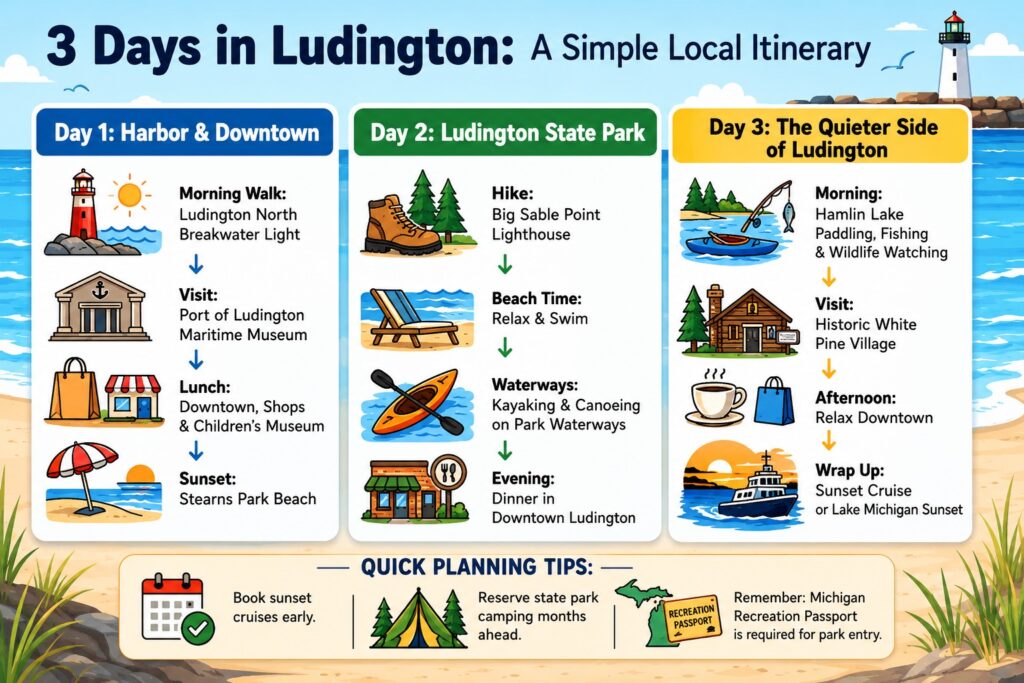
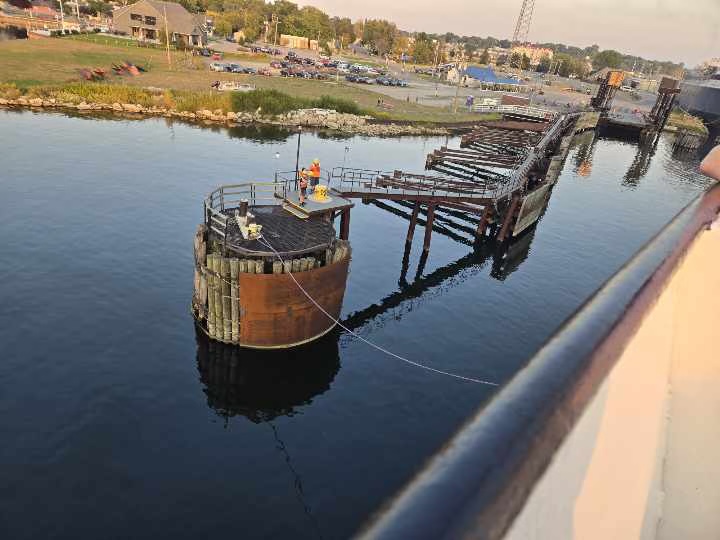
The city of Ludington is a short drive south, with restaurants, shops, and its own Ludington North Breakwater Light for anyone who wants a second lighthouse fix. If you’re coming from or heading toward Wisconsin, Ludington is also the Michigan terminus of the S.S. Badger car ferry, which crosses Lake Michigan to Manitowoc, Wisconsin, in about 4 hours.
Popular nearby attractions include:
- Downtown Ludington
- SS Badger Lake Michigan Ferry
- Stearns Park Beach
- Ludington North Breakwater Light
- Hamlin Lake
- Historic White Pine Village
- Nordhouse Dunes Wildernes
Tips for Visiting
- Arrive early during summer weekends.
- Book campsites months in advance.
- Carry plenty of water on dune hikes.
- Bring bug spray for wooded trails.
- Wear sturdy shoes for sandy terrain.
- Plan at least half a day, though a full day or weekend lets you experience much more.
- Stay for sunset over Lake Michigan – it is one of the park’s biggest highlights.
Frequently Asked Questions
No reservation is required for a day visit — you just need a Recreation Passport on your vehicle to enter. Reservations are only required for overnight stays: campsites, mini cabins, and the pavilion.
Reservations open exactly 6 months ahead of your arrival date through MiDNRReservations.com or by phone. For summer weekends, treat that opening moment like a ticket sale — have your dates and payment info ready, because popular loops can fill within hours.
It’s not technically hard — flat, sandy, 1.8 miles one-way — but the combination of loose sand, minimal shade, and Michigan summer heat makes it more tiring than the mileage suggests. Bring water and sun protection, and budget roughly an hour each way at a relaxed pace.
Yes, the path is open to bikes as well as foot traffic, but it’s sand-and-gravel rather than pavement, which makes it genuinely difficult on a road bike. A mountain or fat-tire bike handles it much better.
Only on one designated pet beach on Lake Michigan, between the beach house and the Big Sable River — the rest of the Lake Michigan shoreline is closed to pets to protect nesting piping plovers, an endangered shorebird. Leashes (6 feet max) are required throughout the park.
No. The Recreation Passport only covers Michigan state parks, recreation areas, state forest campgrounds, state-managed boat launches, and trailhead parking — it does not work at national parks (like nearby Sleeping Bear Dunes) or at county, township, or municipal parks, which have their own fee systems.
Don’t count on it. Cell service is limited across much of the park, especially in the campgrounds, so download offline maps, confirm reservations, and let people know your plans before you arrive.
Yes — Dune Grass Concessions rents kayaks, canoes, and stand-up paddleboards at the Hamlin Lake beach house from mid-May through early October. Call (231) 843-1888 to check availability, especially on busy weekends.
If you don’t check in or contact MiDNRReservations to update your arrival date, the system automatically cancels your reservation, and you’ll lose two nights’ fees plus the non-refundable reservation fee, a $10 cancellation fee, and a reduced-stay fee. This is an automated process that staff cannot override, so if your plans shift, call ahead rather than just arriving late.
No – once you’re in the park with a valid Recreation Passport, the beaches, swim areas, and trails are included at no extra charge. The only add-on fees inside the park are camping, the lighthouse tower climb donation, cabin/pavilion rentals, and rental equipment like kayaks and bikes.
Yes — there’s an outdoor amphitheater available for rent for weddings and other events, with the rental fee covering reserved parking, exclusive use of the facility, electrical service, and nearby restrooms. Call the park office at (231) 843-2423 to check availability and pricing.
Final Thoughts
Ludington State Park stands out because it offers far more than a beach day. Within one park, you can wander through towering dunes, paddle peaceful inland waters, hike to one of Michigan’s most recognizable lighthouses, watch bald eagles soar overhead, and finish the evening with a Lake Michigan sunset. Whether you’re planning a family vacation, a camping weekend, or a scenic stop along Michigan’s west coast, it’s easy to see why this park continues to rank among the state’s favorite outdoor destinations.
More of Wandering Michigan Wisconsin
Lake Michigan Circle Tour: All 4 States, One Local Guide (2026)
Best Lake Michigan Beach Towns: All 4 States Covered (Local Guide 2026)
Car Ferry Across Lake Michigan: SS Badger & Lake Express Guide (2026)
Pictured Rocks: What’s Worth It and What to Skip (2026)
17 Best Things To Do at Tahquamenon Falls


